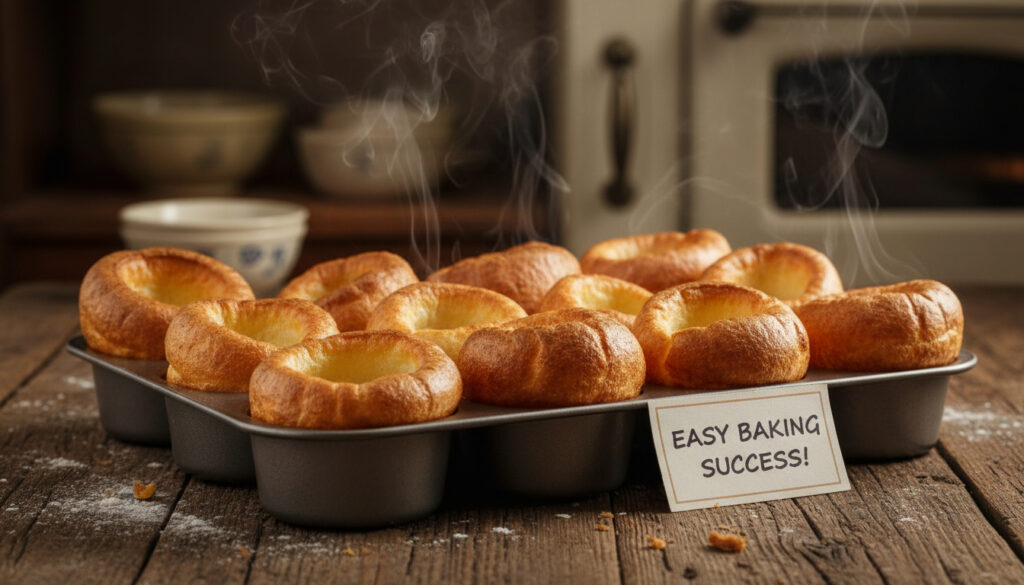
Yorkshire Pudding Recipe for 4 – Easy Guide to Perfect Rise
Yorkshire pudding remains the definitive accompaniment to a traditional English Sunday roast. This simple batter of flour, eggs, and milk transforms in a hot oven into light, puffed pastries with crisp exteriors and hollow centers, designed specifically to capture meat gravy.
Scaled for four diners, this recipe yields eight to twelve individual puddings using a standard muffin tin. The method relies on centuries-old principles: a cold batter meeting smoking-hot fat creates the dramatic rise that defines the dish.
Unlike bread or cake, Yorkshire pudding contains no chemical raising agents. The puff comes entirely from steam generated when the liquid batter hits the hot fat, requiring precise temperature control and disciplined timing.
Ingredients for Yorkshire Pudding for 4
Key Insights for Success
- Hot fat must sizzle audibly on batter contact to prevent oil absorption
- Room temperature ingredients prevent density and ensure proper integration
- Batter resting allows gluten relaxation for maximum rise height
- Plain flour exclusively produces the necessary structure; self-raising flour creates flat results
- Opening the oven door before twenty minutes guarantees collapse from heat loss
- Chilled batter creates taller puddings when hitting the smoking-hot oil
Recipe Snapshot
| Attribute | Details |
|---|---|
| Calories per serving | 100-150 |
| Key Ingredients | Plain flour, eggs, whole milk, beef drippings or oil |
| Equipment | 12-cup muffin tin or Yorkshire pudding tins |
| Oven Temperature | 220°C/425°F (fan 210°C/gas 8) |
| Rest Time | 15-45 minutes |
| Total Time | 35-50 minutes |
| Yield | 8-12 puddings |
| Fat Type | Beef drippings, lard, sunflower oil, or canola oil |
| Flour Type | Plain/all-purpose only (90g) |
| Milk Type | Whole milk, room temperature (240ml) |
| Egg Count | 3 large, room temperature |
| Cost per batch | Approximately $2-3 |
Basic pantry staples keep costs minimal. A typical batch requires roughly $0.20 of flour, $0.75 of eggs, $0.50 of milk, and $0.50 of fat or oil. Specialized dietary adaptations may increase costs by one to two dollars for substitutes.
Step-by-Step Yorkshire Pudding Recipe
Preparing the Batter
Sift three-quarters of a cup of plain flour with half a teaspoon of salt into a mixing bowl. In a separate vessel, whisk three large eggs with one cup of whole milk until blended. Gradually incorporate the wet mixture into the flour, whisking continuously until the batter resembles thin pancake mix. Vigorous whisking for approximately two minutes introduces necessary air, but overmixing develops gluten and creates density.
The final consistency should drip easily from a spoon. If the mixture appears thick, add two to four tablespoons of cold water to thin it.
Resting the Mixture
Cover the bowl and rest the batter for fifteen to forty-five minutes. This pause allows the flour to hydrate fully and the gluten structure to relax, resulting in a taller rise. Resting may occur at room temperature or in the refrigerator; chilled batter actually performs better when hitting the hot fat, though both methods work. Skipping this step produces flat, tough puddings.
Baking Technique
Preheat the oven to 425-450°F (220-230°C). Place one-half to one teaspoon of fat into each cup of a twelve-cup muffin tin. Position the tin on a baking sheet and heat in the oven for ten to fifteen minutes until the fat smokes and sizzles aggressively.
Remove the tin briefly, stir the chilled batter, and pour quickly to fill each cup two-thirds full. The batter should sizzle on contact. Bake undisturbed for five minutes at the initial high temperature, then reduce heat to 375°F (190°C) and continue baking for ten to twenty minutes until the puddings appear golden, puffed, and crispy. Do not open the oven door during the first fifteen minutes.
The fat must reach smoking point before adding batter. Insufficient heat causes the batter to absorb oil rather than flash-steam, resulting in soggy, dense, and greasy puddings. If the fat does not sizzle audibly when a drop of batter touches it, return the tin to the oven for an additional five minutes.
Tips for Perfectly Risen Yorkshire Puddings
Temperature Control
Room temperature eggs and milk incorporate air more efficiently than cold ingredients. Whisk the liquids vigorously before adding to the flour to maximize aeration. The structure from egg proteins provides the scaffold that prevents collapse.
Aeration Techniques
Use plain flour exclusively. Self-raising flour contains baking powder that interferes with the steam-rise mechanism, creating cake-like domes rather than hollow shells. BBC Good Food standards confirm that traditional ratios rely entirely on the steam reaction.
Oven Management
Maintain constant heat. Opening the oven door releases steam and drops the temperature, causing the puddings to deflate immediately. Use the oven light to check progress rather than cracking the seal. Cooking records indicate that even a thirty-second opening can ruin the batch.
Common Mistakes and How to Fix Them
| Issue | Cause | Solution |
|---|---|---|
| Not rising / flat | Cold batter or fat, overmixing, self-raising flour, oven door opened | Use plain flour only, rest batter thirty minutes, ensure maximum heat, avoid disturbances |
| Soggy texture | Insufficient preheat, too much liquid in batter | Preheat oil until smoking, reduce milk or add more water for thinner consistency |
| Dense and heavy | Overmixing, no rest period, wrong flour type | Gentle whisking, mandatory rest, strict use of plain flour |
Opening the oven door before twenty minutes have elapsed causes immediate heat loss and steam escape. This stops the rising process irreversibly. Resist the urge to check progress; use the oven window and light instead.
Plain all-purpose flour contains no raising agents, allowing the steam from the hot fat to create the structure. Self-raising or cake flour produces disappointing, dense results unsuitable for this specific technique.
Non-stick muffin tins or dedicated Yorkshire pudding tins yield the best release. Popover pans work as alternatives but produce taller, narrower shapes. Equipment tests show that dark metal tins conduct heat more effectively than silicone for this application. Yorkshire pudding is the definitive accompaniment to a traditional English Sunday roast, and you can find a recipe for it at Få bort fläckar på madrass. Få bort fläckar på madrass
Quick Recipe Timeline
- Prepare batter: Whisk ingredients to smooth consistency (5 minutes)
- Rest mixture: Allow gluten relaxation (15-45 minutes)
- Preheat tin: Heat fat until smoking point reached (10-15 minutes)
- Bake undisturbed: High heat initial rise, then moderate heat to crisp (15-25 minutes)
- Serve immediately: Puddings begin to deflate within minutes of removal
Recipe Reliability Notes
| Established Information | Variable or Unclear Information |
|---|---|
| Traditional equal-volume ratios of flour, eggs, and milk produce consistent results | Exact minimum resting time; fifteen minutes works but thirty produces marginally better height |
| Hot fat touching batter creates mandatory steam reaction | Precise smoke point variations between sunflower oil, lard, and beef drippings |
| Plain flour exclusively required; raising agents prevent proper rise | Exact temperature adjustments for fan-assisted versus conventional ovens based on specific models |
| Oven door opening collapses rising structure | Optimal timing for reducing oven temperature (some sources suggest five minutes, others ten) |
What Makes Yorkshire Pudding Special
Originating in 1737 in Yorkshire, England, this dish emerged as a thrifty method for poor families to utilize meat drippings and stretch meager batter supplies before the roast itself finished cooking. The name derives directly from the county. Historical records trace its evolution from medieval “batter puddings” cooked beneath roasting meat to capture falling fat.
The dish has become synonymous with British Sunday roast traditions. Culinary documentation identifies the iconic status of the crisp, golden vessels designed primarily to transport gravy from plate to palate.
The science depends on the Leidenfrost effect: when the cold, wet batter hits the fat exceeding 375°F, the immediate steam explosion creates the hollow interior and crisp exterior. James Norton Movies and TV Shows – Full Filmography and Best Roles offers a cultural reference point for understanding British Sunday traditions, though the culinary technique stands independently as a feat of thermodynamics.
Trusted Sources
“The secret to perfect Yorkshire puddings is ensuring your oil is practically smoking before the batter goes in. Use plain flour and never self-raising, and don’t open that oven door.”
— Adapted from BBC Good Food traditional standards
Next Steps
Serve the puddings immediately alongside roast beef and onion gravy for the traditional experience. For those tracking nutritional metrics alongside their meals, How to Work Out BMI – Formulas, Categories and Guide provides calculation methods. Leftover puddings freeze well for up to one month and reheat in a hot oven for five to eight minutes to restore crispness.
Frequently Asked Questions
Can I prepare Yorkshire pudding batter in advance?
Yes. Rest the batter in the refrigerator for up to twenty-four hours. Whisk briefly before using to reincorporate any separation. Chilled batter actually creates taller puddings when hitting hot fat.
Why did my Yorkshire puddings fail to rise?
Common causes include insufficiently hot fat, cold ingredients, overmixing the batter, using self-raising flour, or opening the oven door during the initial fifteen minutes of baking.
Is there a vegan alternative that works?
Replace eggs with nine tablespoons of aquafaba (chickpea liquid) and use plant-based milk such as oat or soy. Use oil rather than drippings. Rest and bake using identical temperature protocols.
How do I reheat leftover puddings without sogginess?
Place fully cooled puddings in a hot oven at 400°F for five to eight minutes. Microwaves produce soggy, rubbery textures and should be avoided.
Can I use an air fryer for this recipe?
Preheat the air fryer to 400°F. Oil ramekins or silicone cups, pour batter, and air fry for ten to fifteen minutes undisturbed. Results produce less puff than oven baking but achieve crispy exteriors.
What causes soggy bottoms in Yorkshire puddings?
Insufficiently preheated oil causes the batter to absorb fat rather than flash-fry. Ensure the fat smokes before adding batter, and avoid using too much liquid in the mixture.
More related posts
 One For All Gift Card – Where to Use and Key Facts
 DHS Revokes Humanitarian Parole – CHNV Impacts on 532K Migrants
 Black Cats Jordan 4: 2025 Price, Release Date & Value
 Jamaica National Football Team Games – Schedule, Results and Updates
 Part Time Jobs Liverpool: 20K+ Openings & Student Tips
 Do I Need a TV Licence to Watch Netflix? Ireland & UK Guide
 Reece Shearsmith: Biography, Career, and Personal Life
 Jean-Claude Van Damme: Biography, Health & Martial Arts
